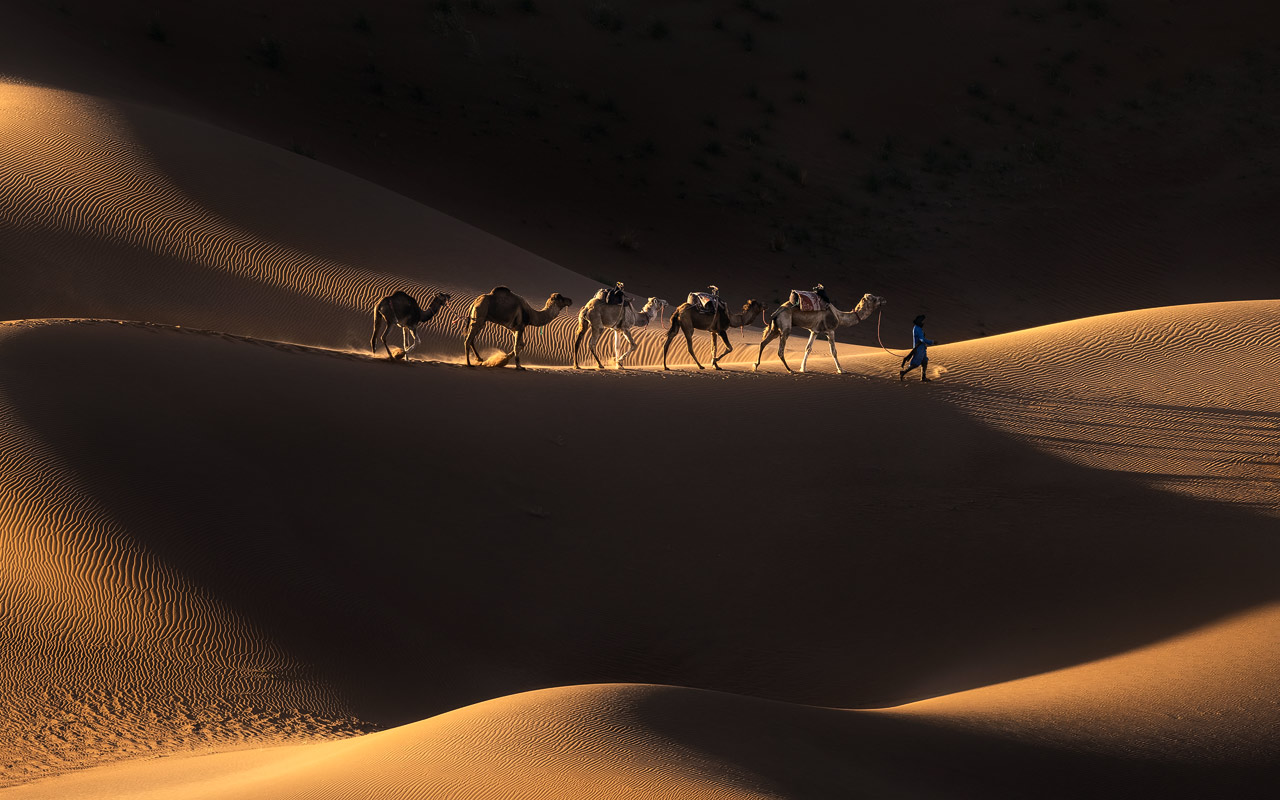
4 locations: Marrakech Palmeraie (1h, from €25), Agafay Desert sunset (2h, from €35), Agafay dinner + camel (evening, from €65), Sahara Desert/Merzouga (sunset + sunrise trek, included in 3-day tours from €95). All camels are dromedaries (1 hump). First-timers: The camel rises back legs first — lean back and hold the saddle. 1–2 hours is comfortable for beginners. Wear: Long trousers, closed shoes, sun hat, scarf for Sahara wind.
Where to Ride — 4 Locations Compared

| Location | Duration | From | Terrain | Best For | MDT Tour |
|---|---|---|---|---|---|
| Palmeraie | 1 hour | €25 | Palm groves, flat | Families, first-timers, short on time | Book → |
| Agafay Desert (sunset) | 2 hours | €35 | Rocky desert hills | Sunset photos, desert feel near Marrakech | Book → |
| Agafay (dinner + camel) | Evening | €65 | Rocky desert + camp | Sunset ride + Berber dinner + bonfire | Book → |
| Sahara (Merzouga) | 1.5h sunset + 1h sunrise | Incl. in tours from €95 | Erg Chebbi sand dunes | Bucket-list Sahara experience | Book → |
Choosing: Short on time → Palmeraie (15 min from Marrakech, 1 hour ride). Want desert vibes without a 3-day trip → Agafay (45 min from Marrakech). Want the real Sahara dunes → Merzouga (included in every 3-day+ desert tour). Can’t decide between deserts? Compare Agafay vs Merzouga vs Zagora →

What to Expect — First-Timer’s Guide

The motion: Riding a camel feels nothing like riding a horse. Camels have a slow, swaying gait that rocks you side to side and front to back simultaneously. It takes a few minutes to find your rhythm — once you do, it’s surprisingly relaxing. Think of it as a gentle rocking chair, not a rollercoaster.
Comfort: First-timers are comfortable for 1–2 hours. Beyond that, inner thighs and lower back can start to ache. The traditional wooden saddle with blankets is functional, not luxurious. Long trousers prevent chafing. If you’re doing a longer Sahara trek, the guide will stop regularly so you can stretch.
Dromedary, not Bactrian: All camels in Morocco are dromedaries (Camelus dromedarius) — the single-humped species native to North Africa and Arabia. Bactrian camels (two humps) live in Central Asia. Dromedaries are taller, faster, and better adapted to hot climates. In Morocco, locals simply say “camel” — the correct zoological term is dromedary.
How to Ride — Mounting, Controlling & Dismounting

Mounting
The camel kneels on the ground for you to get on. Your guide commands it to lower itself. Step 1: Place your left foot in the stirrup and swing your right leg over — like mounting a horse. Step 2: Grip the front of the saddle firmly. Step 3: The camel rises back legs first — this pitches you forward suddenly. Lean back to counterbalance. Then the front legs rise and you level out. It feels dramatic the first time, but it’s completely normal.
Riding
On most MDT tours, your guide leads the camel by a rope — you don’t need to steer. Just hold the saddle, relax your body, and sway with the rhythm. If you’re given reins: gentle pressure on the right rein to turn right, left rein to slow down. Camels respond to steady, gentle movements — never pull sharply. Stay relaxed: camels sense tension and may become uneasy.
Dismounting
The reverse of mounting: the camel kneels front legs first this time, pitching you forward. Lean back, hold the saddle, and wait until it’s fully down before swinging your leg off. Your guide will steady the camel.
Camel Behaviour & Safety
Camels are docile, patient animals when properly handled — they’ve been domesticated for thousands of years. But they’re not horses, and a few rules keep everyone safe:
Don’t stand behind a camel — they can kick in all four directions (unlike horses, which only kick backward). Don’t pet a camel’s face without the handler’s permission — some camels don’t like it. Keep food sealed — camels are curious and will grab snacks from open bags or hands. Follow your guide’s instructions — they know each camel’s temperament.
Children: Ages 4+ can ride with an adult on the same camel. Ages 8+ can typically ride solo. Not recommended during pregnancy or for people with serious back conditions. Most camel rides are suitable for all fitness levels — no experience needed.
Camel Welfare — How MDT Operates

We take camel welfare seriously. Our camels are owned and cared for by local Berber families who have raised dromedaries for generations — they’re working partners, not commodities. Proper loading: One adult per camel (or one adult + small child). Rest periods: Camels rest between rides, with shade, water, and food. Veterinary care: Regular check-ups. No riding in extreme heat: Summer rides are scheduled for early morning or late afternoon.

What to Wear & Bring
Essential: Long trousers (the saddle chafes bare legs), closed-toe shoes, sun hat, sunscreen (SPF 50+), and a scarf or turban for Sahara rides (wind and sand protection — you can buy a traditional blue turban at Aït Benhaddou on the way for ~20 MAD).
For sunset/evening rides: Bring a warm layer — temperatures drop fast after sunset, especially in Agafay and the Sahara. Camera: Sunset camel rides are the most photogenic Morocco experience. Secure your phone with a lanyard or pocket — dropping it from camel height into sand is no fun.
Full packing list: What to Pack for a Morocco Tour.
Camels in Moroccan Culture
Dromedaries — often called the “ships of the desert” — have been integral to North African life for thousands of years. They carried goods along the ancient trans-Saharan salt and gold trade routes that connected Timbuktu to Marrakech and beyond. The relationship between Berber and Nomadic communities and their camels is one of mutual dependence — camels provided transport, milk, wool, and meat in environments where no other animal could survive.
Today, the Tan-Tan Moussem (a UNESCO-recognized festival in southern Morocco) celebrates this heritage with camel races, beauty contests, and trading. While modern vehicles have replaced camels for transport, the cultural bond remains strong — and the sunset camel trek across Erg Chebbi dunes is now one of Morocco’s most iconic visitor experiences.
Where: Palmeraie (€25, 1h), Agafay (€35, 2h), Agafay dinner (€65), Sahara (incl. in tours from €95).
Type: Dromedary (1 hump) — not Bactrian. Docile, well-adapted to desert.
Mounting: Camel rises back legs first — lean back, hold saddle. Over in 5 seconds.
Comfort: 1–2 hours ideal for first-timers. Long trousers prevent chafing.
Safety: Don’t stand behind, keep food sealed. Ages 4+ with adult, 8+ solo.
Best time: Oct–May. Summer: early morning or late afternoon only.