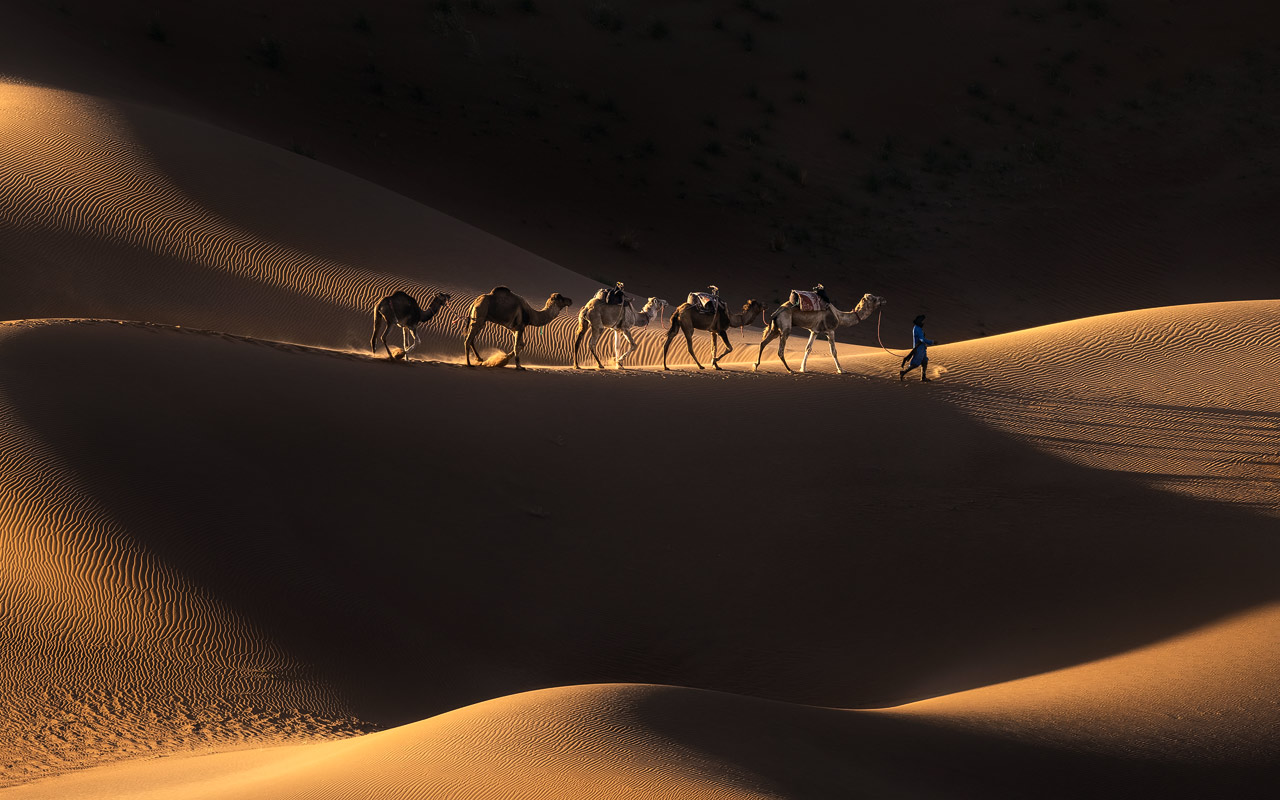
The Sahara is the world's largest hot desert (9.2M km², 3rd overall after Antarctica and the Arctic). "Sahara" comes from Arabic ṣaḥrāʾ meaning "desert." Only 25% is sand — the rest is rocky plateau, gravel, and mountains (highest: Emi Koussi, 3,415m). Summer temps reach 46°C; winter nights drop below 0°C. It was green savanna ~5,000 years ago and cycles every 41,000 years. Its dust crosses the Atlantic to fertilise the Amazon rainforest. Wildlife includes the Fennec fox, Dorcas gazelle, and desert cheetah. Filmed in: Star Wars (Tatooine). Visit: 3-day Merzouga tour from €95.
15 Facts at a Glance
| # | Fact | Detail | Category |
|---|---|---|---|
| 1 | Largest hot desert | 3rd largest overall (after Antarctica, Arctic) | Size |
| 2 | 9.2 million km² | ~Size of the US. Spans 10 countries | Size |
| 3 | Name means “desert” | Arabic ṣaḥrāʾ = desert. Tautological name | Culture |
| 4 | Dunes up to 180m | Ergs (sand seas) — nearly half the Empire State Building | Geology |
| 5 | Tuareg & Berber homeland | Nomadic tribes adapted to extreme conditions for millennia | Culture |
| 6 | 46°C summers | Below 0°C winter nights. Daily swing up to 40°C | Climate |
| 7 | Dinosaur fossils | Spinosaurus, Carcharodontosaurus found in Saharan rock | Geology |
| 8 | Only 25% sand | 75% is rocky plateau (hamada), gravel (reg), mountains | Geology |
| 9 | Emi Koussi — 3,415m | Highest point: a volcano in Chad’s Tibesti Mountains | Geology |
| 10 | Fennec fox & desert wildlife | Dorcas gazelle, desert cheetah, monitor lizards, scorpions | Wildlife |
| 11 | 20+ lakes & oases | Plus khettara underground irrigation (Morocco-specific) | Wildlife |
| 12 | Star Wars filming location | Tunisia’s desert = planet Tatooine | Film |
| 13 | Expanded 10% in 100 years | Climate change + natural cycles driving growth | Climate |
| 14 | Green every 41,000 years | Was savanna with lakes, hippos, crocodiles ~5,000 years ago | Climate |
| 15 | Dust fertilises the Amazon | ~22,000 tonnes/year of Saharan phosphorus crosses the Atlantic | Climate |
Size & Geography

The Sahara covers 9.2 million square kilometres — roughly the size of the United States or China. It stretches across 10 North African countries: Morocco, Algeria, Tunisia, Libya, Egypt, Mauritania, Mali, Niger, Chad, and Sudan. Despite being the world’s most famous desert, it ranks third in total area after the cold deserts of Antarctica and the Arctic. It holds the title of the world’s largest hot desert.
The name “Sahara” comes from the Arabic word ṣaḥrāʾ, meaning simply “desert” — making “Sahara Desert” a tautology (desert desert). Only about 25% of the Sahara is sand (called ergs or sand seas). The remaining 75% is rocky plateau (hamada), gravel plains (reg), dry valleys, mountains, and oases. The sand dunes that do exist can reach up to 180 metres in height — nearly half the Empire State Building.
The Sahara’s highest point is the Emi Koussi volcano (3,415m) in Chad’s Tibesti Mountains — higher than any peak in the Atlas range outside of Toubkal.
Climate & the Green Sahara Cycle

Summer temperatures in the central Sahara regularly reach 38–46°C (100–115°F). The highest reliably recorded temperature in Africa was 55°C in Kebili, Tunisia. But the Sahara is also surprisingly cold: winter nights can drop below 0°C, especially at altitude, and the daily temperature swing can be 30–40°C — from scorching noon to near-freezing midnight.
Perhaps the most surprising fact: the Sahara was green savanna as recently as 5,000–11,000 years ago. During the “African Humid Period,” it had lakes, rivers, and abundant wildlife — rock art across the region depicts hippos, crocodiles, and cattle grazing. This cycle repeats roughly every 41,000 years, driven by shifts in Earth’s axial tilt that strengthen or weaken the North African monsoon.
In the other direction: the Sahara has expanded by roughly 10% over the last century, driven by both natural climate cycles and human-caused climate change. This desertification threatens agricultural communities on the desert’s southern edge (the Sahel).
And perhaps the most surprising connection of all: Saharan dust fertilises the Amazon rainforest. Every year, roughly 22,000 tonnes of phosphorus-rich dust is lifted from the Bodélé Depression in Chad and carried across the Atlantic by trade winds — a 5,000 km journey. This mineral input replaces nutrients washed away by tropical rainfall, making the world’s driest desert essential to the survival of its wettest forest.
Wildlife & Water

The Sahara is far from lifeless. Its most iconic resident is the Fennec fox (Vulpes zerda) — the world’s smallest fox, with oversized ears that dissipate heat and detect prey underground. Other wildlife includes the Dorcas gazelle, desert cheetah (critically endangered), monitor lizards, deathstalker scorpions, and dromedary camels (domesticated, not wild — see our camel rides guide).
Despite its arid reputation, the Sahara has over 20 permanent lakes and numerous oases — critical water sources for both wildlife and human communities. In Morocco, the ingenious khettara underground irrigation system (a network of hand-dug tunnels that channel groundwater to the surface) has sustained oasis agriculture for centuries. Read about Morocco’s khettaras →

Culture & History

The Sahara has been inhabited for at least 10,000 years. Today, Tuareg and Berber (Amazigh) nomadic tribes continue to traverse the desert, preserving traditions of trade, herding, and craftsmanship passed down through generations. The ancient trans-Saharan trade routes connected sub-Saharan gold and salt to Mediterranean markets — and the camel caravans that carried these goods are the cultural ancestors of today’s tourist camel treks.
The Sahara has also yielded remarkable dinosaur fossils — including Spinosaurus (the largest known carnivorous dinosaur, bigger than T. rex) and Carcharodontosaurus, both discovered in Saharan rock formations that were once riverbeds. Near Erfoud on the Morocco–Sahara edge, trilobite fossils are so abundant that local artisans polish them into decorative objects sold in markets.
The Sahara in Pop Culture
The Sahara’s dramatic landscapes have captivated filmmakers for decades. Most famously, the desert landscapes of Tunisia became the planet Tatooine in Star Wars — the name itself is derived from the Tunisian town of Tataouine. Lawrence of Arabia (1962) filmed extensively across Saharan locations, and Morocco’s own Ouarzazate has served as a stand-in for desert scenes in Gladiator, Game of Thrones, and dozens of other productions (see our kasbah guide for the film connection).
In literature, Antoine de Saint-Exupéry drew on his Saharan flying experiences for The Little Prince (1943), and Paul Bowles‘ The Sheltering Sky (1949) remains the defining novel of the North African desert.
Visiting Morocco’s Sahara

You don’t need to cross the entire Sahara to experience it. Morocco’s Erg Chebbi dunes near Merzouga are the most accessible entry point — reachable in a 3-day tour from Marrakech that crosses the Atlas Mountains and visits Aït Benhaddou en route.
| Tour | Duration | Dunes | From |
|---|---|---|---|
| Shared Merzouga Tour | 3 days | Erg Chebbi | €95 |
| Private Merzouga Tour | 3 days | Erg Chebbi | €195 |
| Private 4-Day Extended | 4 days | Erg Chebbi + Todgha | €275 |
| Marrakech → Fes via Sahara | 3 days | Erg Chebbi | €169 |
All tours include camel trek at sunset, overnight in a Sahara camp (standard or luxury), sunrise over the dunes, and the crossing of the Atlas Mountains via Tizi n’Tichka. Full Sahara planning guide →
Size: 9.2M km² — world’s largest hot desert. 10 countries. Only 25% sand.
Climate: 46°C summers, below 0°C winter nights. 30–40°C daily swings.
Green cycle: Was savanna ~5,000 years ago. Cycles every 41,000 years.
Wildlife: Fennec fox, Dorcas gazelle, desert cheetah, 20+ lakes.
Film: Star Wars (Tatooine = Tunisia). Lawrence of Arabia. Ouarzazate = Morocco’s Hollywood.
Visit: Erg Chebbi (Merzouga) — 3-day tour from Marrakech from €95.